Large-Scale, Non-Retail Engagement
Finova’s engagement in industrial and base metals is focused on physical, large-scale materials in non-retail, off-market contexts where supply chain integrity, jurisdictional considerations, and governance are central.
This is not exchange trading, commodity brokerage, or speculative investment activity.
Engagement is selective and structured, reflecting the operational and regulatory complexity of industrial metal markets.
Scope of Engagement
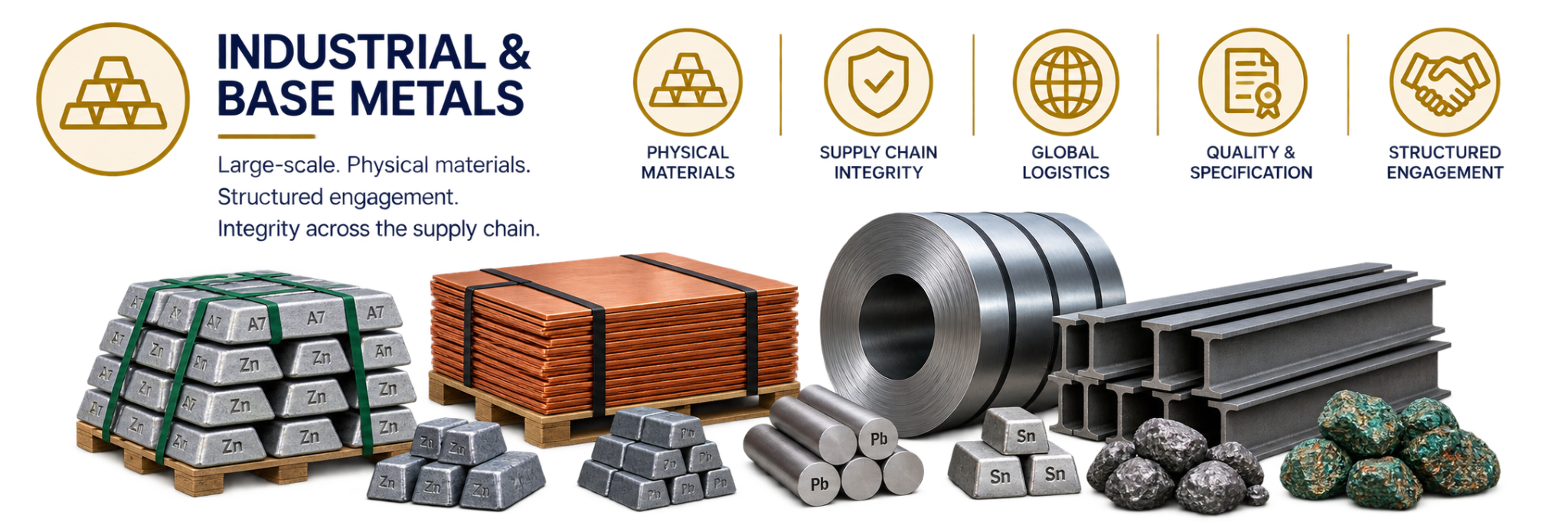
Finova may engage in industrial and base metal contexts involving physical material used in manufacturing, infrastructure, energy, or strategic industrial applications, including for example copper cathode, aluminium (A7 and related grades), zinc, lead, nickel, tin, cobalt, and manganese, where engagement is structured and lawfully supported.
Engagement is typically characterised by:
- industrial or institutional end-use requirements,
- complex supply chains and logistics, and
- cross-border movement with jurisdiction-specific regulatory considerations.
Retail metal trading, exchange-based exposure, and speculative commodity activity fall outside this scope.
Physical Materials Only
Finova’s engagement is limited to physical industrial and base metals.
We do not engage in:
- futures, options, or derivatives,
- exchange-traded metal instruments, or
- purely financial or speculative metal products.
This distinction is fundamental to Finova’s operating model and governance posture.
Supply Chain, Specification, and Legitimacy
Industrial and base metals present inherent risks relating to:
- origin and production,
- specification and grading,
- substitution or misrepresentation, and
- logistics and delivery integrity.
Finova approaches these contexts with an emphasis on:
- clarity of material specification and grade,
- lawful origin and authority to supply,
- consistency of technical, commercial, and logistical information, and
- alignment with applicable regulatory and trade requirements.
Engagement does not proceed where these elements cannot be reasonably established.
Jurisdictional and Regulatory Considerations
Industrial and base metals are frequently subject to:
- export and import controls,
- sanctions and trade restrictions, and
- jurisdiction-specific regulatory and customs requirements.
These considerations vary materially by metal type, origin, and destination.
Finova’s engagement is therefore informed by:
- awareness of applicable legal and regulatory frameworks, and
- proportionate verification aligned to the risks presented.
Further detail on these considerations is addressed within Governance & Compliance.
Structured, Disciplined Engagement
Where alignment exists, Finova’s role is to support structured, disciplined engagement rather than to facilitate volume trading or market-making activity.
This may include:
- supporting clarity between counterparties,
- ensuring appropriate governance expectations are understood, and
- reducing the risk of uncontrolled circulation or misrepresentation.
What This Is Not
To avoid misalignment, it is important to be clear about what Finova does not do in this area.
Finova does not:
- act as a base metals trader or broker,
- participate in retail or exchange-based metal markets,
- promote speculative metal investment activity, or
- engage in purely financial exposure to industrial metals
Indicative, Not Exhaustive
The above is indicative of Finova’s engagement in industrial and base metals rather than exhaustive.
Exceptional or non-standard contexts may be considered on a case-by-case basis where alignment clearly exists. Such consideration should not be assumed.
Clarity First
Industrial and base metals underpin global industry and infrastructure but carry meaningful operational and regulatory risk.
Where alignment exists, engagement proceeds thoughtfully.
Where it does not, clarity is provided early.